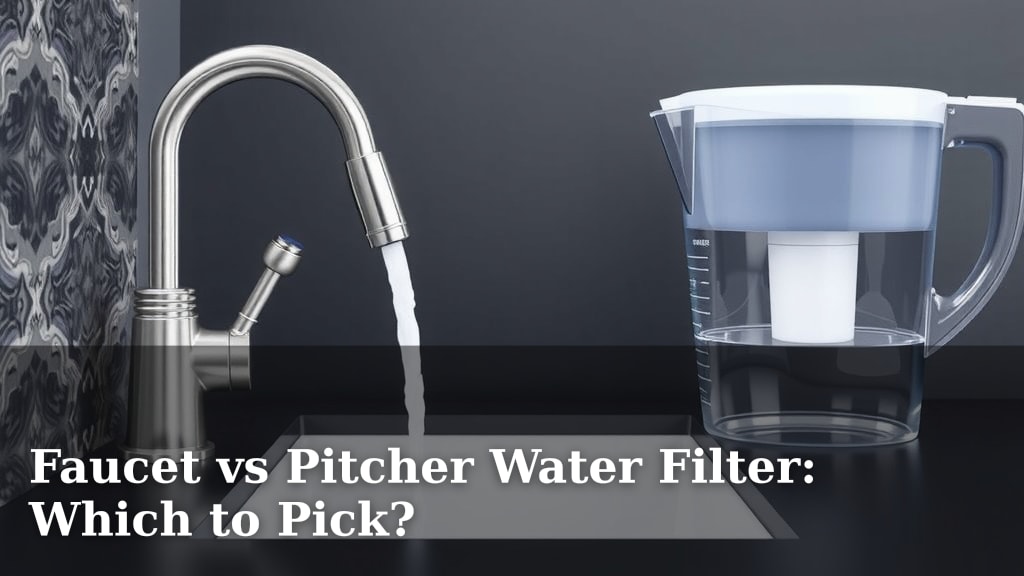
Faucet vs Pitcher Water Filter: Which to Pick?
When deciding between a faucet water filter and a pitcher water filter, the best choice for you really depends on your needs and habits. Faucet filters offer convenience and instant filtered water directly from your tap, while pitcher filters are more portable and require less installation, making them a great option for renters or those who want filtered water on the go.
Both filter types aim to improve the taste and quality of your drinking water by removing common impurities like chlorine and sediment. We found that the choice often comes down to how much filtered water you use daily and whether you prefer an easy setup or a more flexible solution.
- Faucet filters attach directly to your faucet.
- Pitcher filters sit in your fridge for chilled water.
- Faucet filters provide on-demand filtered water.
- Pitchers are great for smaller households or portability.
- Consider your daily water consumption and installation comfort.
Below, we’ll break down the pros and cons of each to help you make the perfect pick for your kitchen.
Choosing the Right Water Filter: Faucet vs. Pitcher
Deciding between a faucet water filter and a water filter pitcher can feel like a big choice for your kitchen. Both aim to give you cleaner, better-tasting water. We’ve looked into how each works and what benefits they offer.
Your daily water habits are key here. How much filtered water do you drink? Do you need it instantly, or can you wait a bit? These questions will guide you to the best filter for your home.
Understanding Faucet Water Filters
A faucet filter attaches directly to your existing kitchen faucet. It’s a small device that you turn on and off. When you want filtered water, you simply flip a switch. This makes getting clean water incredibly **quick and easy**.
Installation is usually straightforward. Most models don’t require tools. You just screw the filter onto the end of your faucet. We found that most people can set them up in just a few minutes. This is a big plus if you’re not handy with tools.
Pros of Faucet Filters
- Instant Filtered Water: You get clean water on demand. No waiting required.
- Convenient: It’s right there when you need it. Just turn the tap.
- Space-Saving: It doesn’t take up extra counter or fridge space.
- Easy Installation: Most can be installed without any plumbing knowledge.
Cons of Faucet Filters
- Compatibility Issues: They might not fit all faucet types. You should check first.
- Flow Rate Reduction: Filtered water may come out slower than unfiltered water.
- Aesthetics: Some people don’t like the look of a filter on their faucet.
- Filter Replacement: You’ll need to replace filters regularly, typically every 2-3 months.
Exploring Water Filter Pitchers
A water filter pitcher is a portable container that holds water. You fill it up, and the water slowly filters through. It then sits in your refrigerator, ready to pour. This gives you chilled, filtered water whenever you want it.
Pitchers are a great choice for people who rent their homes. They require **no installation** at all. You can also take them with you if you move. This flexibility is a major advantage for many households.
Pros of Water Filter Pitchers
- Portability: You can move it around easily. Take it from the fridge to the table.
- No Installation Needed: Just fill it and let it work its magic. Perfect for renters.
- Chilled Water: It keeps your filtered water cool and refreshing.
- Cost-Effective: Pitchers are generally less expensive upfront than faucet filters.
Cons of Water Filter Pitchers
- Slower Filtration: You have to wait for the water to filter through.
- Limited Capacity: You can only filter a certain amount of water at a time.
- Requires Fridge Space: The pitcher needs room in your refrigerator.
- Manual Refilling: You need to remember to fill it up regularly.
Key Differences and Considerations
When comparing faucet filters and pitchers, think about how you use water daily. Do you fill up large water bottles often? Or do you just need a glass of water now and then?
We found that filter performance can vary. Both types can remove common contaminants like chlorine and sediment. Some advanced models can tackle lead and other impurities. Always check the product’s specifications for what it removes.
Filtration Performance
Both faucet filters and pitchers are designed to improve water quality. They typically reduce chlorine, which affects taste and odor. Many also filter out sediment, improving clarity. Research from the **National Sanitation Foundation (NSF)** shows that certified filters meet strict standards for contaminant reduction.
Faucet filters often have a more robust filtration system. This is because they have more space for filter media. They can sometimes offer longer filter life compared to pitchers. However, pitcher filters have improved greatly over the years. Many now offer comparable filtration levels for common impurities.
Daily Water Usage and Speed
Your daily water consumption is a major factor. If you use a lot of filtered water for drinking, cooking, and filling bottles, a faucet filter might be better. It provides a continuous supply without refilling. This can save you a lot of time throughout the day.
Pitchers are ideal for smaller households or individuals. If you only drink a few glasses of water a day, a pitcher works well. The waiting time for filtration is usually not an issue. For larger families, constantly refilling a pitcher can become a chore. We found that people with high water usage often prefer the convenience of a faucet filter.
Installation and Maintenance
Installation is a clear win for pitchers if you prefer no setup. They are ready to go straight out of the box. Faucet filters, while generally easy to install, do require attaching them to your faucet. This might involve a quick trip to the hardware store if you don’t have the right adapter.
Maintenance for both involves replacing the filter cartridges. The lifespan of these filters varies by brand and model. It’s important to keep track of when to replace them to ensure optimal filtration. Many manufacturers recommend replacing filters every 2-3 months. This helps maintain water purity and filter efficiency (CDC).
| Feature | Faucet Filter | Pitcher Filter |
|---|---|---|
| Installation | Attaches to faucet, usually tool-free | None, just fill and chill |
| Water Access | On-demand, instant | Requires filtering time, then chilled |
| Portability | Fixed to faucet | Highly portable |
| Space Needed | Minimal, on faucet | Countertop or fridge space |
| Ideal User | High water usage, convenience seekers | Low water usage, renters, portability needs |
| Filter Lifespan | Typically 100-300 gallons | Typically 40-80 gallons |
Choosing the right filter depends on your specific needs. Consider these points to help you decide:
- Your tap’s compatibility with faucet filters.
- How much water you drink daily.
- Your comfort level with minor installation.
- Whether you need chilled water instantly.
- Your budget for initial purchase and replacements.
- If you rent or plan to move soon.
Conclusion
Choosing between a faucet filter and a pitcher filter boils down to your lifestyle. If you need instant access to filtered water for a high-demand kitchen, a faucet filter is your go-to for its convenience and speed. For those in apartments, with lower water needs, or who value portability, a pitcher offers a simple, no-fuss solution. Both improve water quality, so consider your daily habits and kitchen setup. Your next step is to check your faucet’s compatibility if you’re leaning towards a faucet filter, or measure your fridge space if a pitcher feels more fitting. You’ve got this!
Frequently Asked Questions
How often do I need to replace the filters for each type?
Filter replacement frequency varies by model and usage. Generally, faucet filters last longer, often filtering 100-300 gallons, while pitcher filters might handle 40-80 gallons. You’ll typically replace pitcher filters every 2-3 months and faucet filters every 4-6 months, but always check the manufacturer’s recommendation.
Can I use a faucet filter if I have a pull-down or spray faucet?
This is a common concern, and it’s important to check compatibility. Many faucet filters are designed for standard spout faucets. Some brands offer adapters or specific models for pull-down or spray faucets, so always research this before purchasing.
Will a faucet filter affect my water pressure significantly?
Yes, a faucet filter can reduce your water pressure slightly. The filtration process creates a small resistance. We found that most users find the reduction acceptable for everyday use, but it’s something to be aware of if you have very low water pressure to begin with.
Are pitcher filters good enough for removing contaminants like lead?
Many modern pitcher filters are NSF-certified to reduce specific contaminants, including lead. It’s vital to check the product specifications and certifications to ensure the pitcher you choose meets your needs for contaminant removal, as not all pitchers filter the same things.
Which option is more environmentally friendly?
Both have environmental impacts. Faucet filters reduce plastic waste from bottled water and have longer-lasting filters. Pitcher filters also reduce plastic waste compared to bottled water, but the plastic pitcher itself and more frequent filter replacements contribute to waste. Reusable faucet filters or durable pitcher materials can help reduce this impact.